Build a Collective Intelligence in your organization to employ more, build cohesive teams who work less (4 day weeks), are more productive, less stressed, and use AI and advanced systems.
A number of years ago, I created a framework to illustrate my interpretation of a “Collective Intelligence” and more recently, this resurfaced as a suggestion in creating a more sustainable workforce with AI.
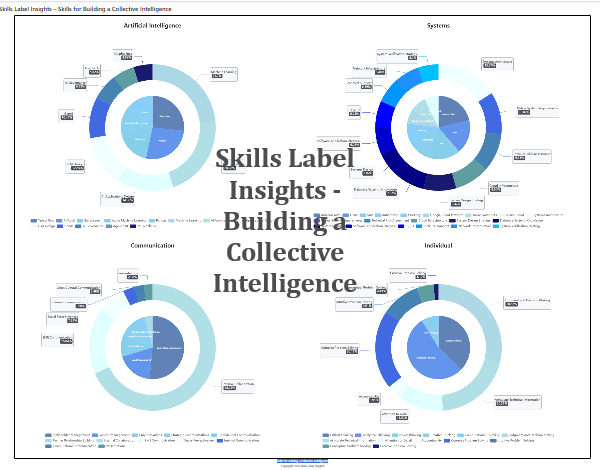
For the 16th Skills Label Insights report “Skills for Building a Collective Intelligence”, I take a quantitative approach in aggregating the main skill areas (I think) a corporation should focus on to develop a Collective Intelligence: Artificial intelligence, Systems, Communication (cohesive team), and Individual (the worker). The aggregations are based on actual skill requirements from current job listings.
In Artificial Intelligence skills, corporations seek competencies in: building AI (ML Pipelines, AI Applications Design, or LLM Design), utilizing AI (Agentic AI, Generative AI, or AI Applications), or governing AI (AI Governance or AI Privacy). Python and its related libraries are foundational to much of the software development.
Regarding Systems, organizations utilize Amazon, Google, and Azure to construct Cloud and Systems Infrastructure across the entire Systems Development Lifecycle.
A significant proportion of job requirements emphasize collaboration across teams, occasionally involving matrix structures (Internal Collaboration). This includes functioning as a Subject Matter Expert (SME Communication) while effectively managing stakeholders (Stakeholder Management).
Our skill classification incorporates four dimensions for describing Problem Solving. Consequently, in the development of a Collective Intelligence, each employee contributes their unique strength:
- Resolving operational incidents (Intuitive Problem Solving),
- Designing and implementing systems (Complex Problem Solving),
- Generating novel concepts and solutions (Creative Problem Solving),
- Overseeing projects (Conceptual Problem Solving).
Finally, there are multiple thinking skills that contribute to a Collective Intelligence not all related to an individual's personal cognitive abilities.
All charts are derived solely from the Skills Label data. The complete report is accessible as a PDF and a live interactive version.
We should organize work as a series of Relay Races rather than focusing on Individual Sprints.