Our rationale for Skill Points is clear and unequivocable:
Quantify learning expectations, job past experience requirements and first year usage rates, and project specifications with a single unifying measurement.
The benefits are also clear:
Map learning and training pathways, give prospective job candidates objectives or goals, and improve job sourcing and onboarding efficiencies.
Thus far, the POV is the second proposed benefit, with a series of nine Skills Label Insights reports with Skill Points as a focal point. There are 3,000+ downloads of the reports since the June release. Momentum is challenging, particularly with entrenched companies. Though, there is progress:
- Daily click-rates and processing of each label are increasing (1M total views).
- App downloads are increasing. A WIFM for the labels.
We were offered an opportunity to submit a federal grant to work on the Skill Coefficients with the Skill Points algorithm. As the graphic shows, our intent is to incorporate data science practices with Skill Points (an early interpretation is provided in the granted patent document).
Some questions I get asked regarding Skill Points:
How do you verify Skill Points, if someone completes a task or activity, project, or course, how do you verify the person actually completed the necessary learning and earned the Skill Points?
Upfront, the intent is to establish the expectation, so the goal is to set the expectation as accurately as possible. Three ways we accomplish this:
- encouraging anchoring the expectations to actual standards, a majority of labels in the Learning Label Catalog reference an education standard
- a peer review process, built into the apps, to verify the “front-facing” inputs of the algorithm, such as time, level of difficult, frequency and intensity each skill is applied
- offering an evaluation process, quizzing before, during, and after someone “consumes or completes” the activity, task or experience
How do you verify Skill Points where skills are applied differently with companies and across industries and sectors?
While there is an opportunity to reference standards, certifications and earned credentials to anchor the Skill Points allotments, another proposal is to view Job Label Skill Point aggregates. To address the variation of skills applications, companies are strongly encouraged to calibrate their own skill requirements using a Job Label Template.
Contact me if your organization would like to learn more regarding Skill Points derivations or would like to participate in how they work.
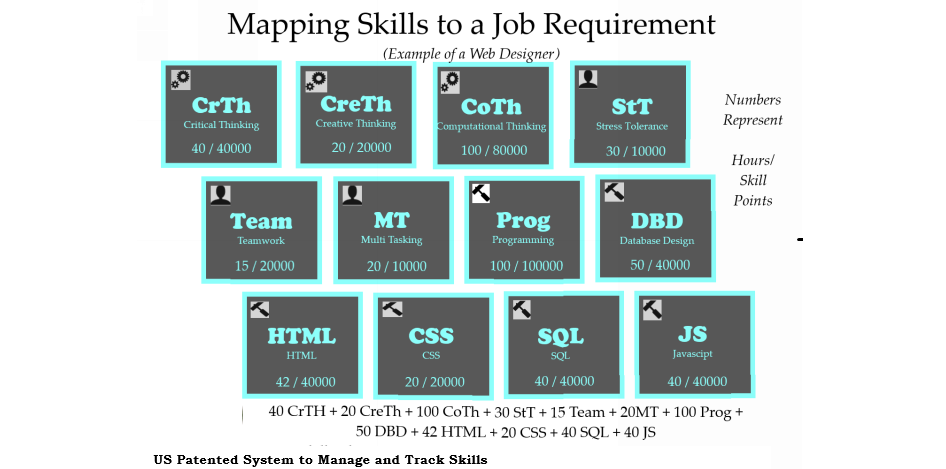
The skills listed in the graphic (the numbers representing hours and Skill Points) are:
- CrTh (Critical Thinking): 40/40000
- CreTh (Creative Thinking): 20/20000
- CoTh (Computational Thinking): 100/80000
- StT (Stress Tolerance): 30/10000
- Team (Teamwork): 15/20000
- MT (Multi Tasking): 20/10000
- Prog (Programming): 100/100000
- DBD (Database Design): 50/40000
- HTML (HTML): 42/40000
- CSS (CSS): 20/20000
- SQL (SQL): 40/40000
- JS (Javascript): 40/40000